“Our main criteria are a high quality of life,
human dignity and unlocking the potential of every individual.”
- Shavkat Mirziyoyev, President of the Republic of Uzbekistan,
St. Petersburg International Economic Forum, 5 June 2026.
These words reflect the underlying philosophy of the transformations taking place in Uzbekistan: the true value of reforms lies in their impact on people’s lives.
Human dignity is not merely a constitutional principle or a commitment declared at international forums. It must be embodied in the protection of individual rights, access to justice, social integration and the provision of opportunities for every person to realise their potential.
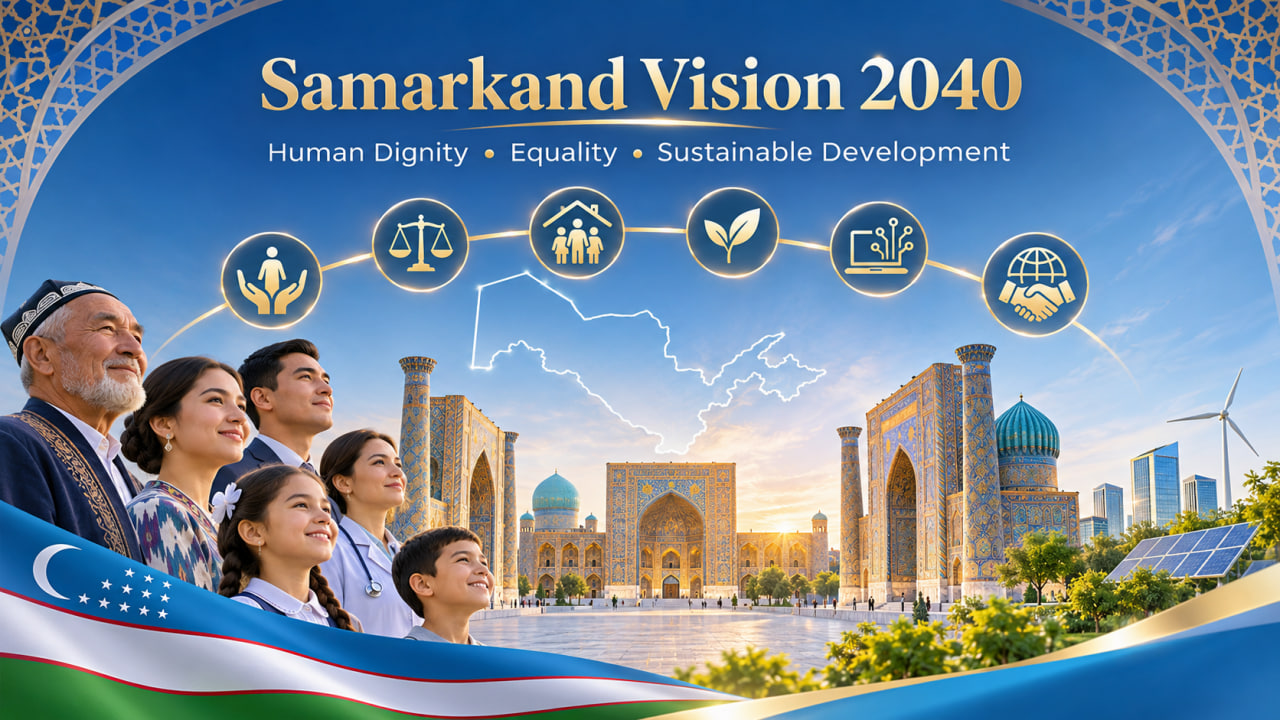
This understanding also lies at the heart of Samarkand Vision 2040.
The recent issuance of the outcome document of the Fifth Samarkand Forum, entitled “Samarkand Vision 2040: Global Partnership for Human Dignity, Equality and Sustainable Development,” as an official document of the 81st session of the United Nations General Assembly (A/81/444) represents an important milestone in Uzbekistan’s international engagement on human rights.
In assessing the significance of this document, one important consideration deserves particular attention. Today, the principal challenge facing the international community in the field of human rights is not merely to proclaim new principles. More importantly, it is to ensure the effective implementation of existing international obligations through national legislation, public administration and people’s everyday lives.
In this context, Samarkand Vision 2040 deserves attention not simply as a broad vision of the future, but as an important initiative aimed at connecting international standards with national experience.
In his address to the 78th session of the United Nations General Assembly on 19 September 2023, President of the Republic of Uzbekistan Shavkat Mirziyoyev emphasized the principle of “For Human Dignity and the Interests of the People” as the central idea underlying the reforms being implemented in our country. This approach acquired a firm legal foundation in the revised Constitution adopted in 2023.
Article 54 of the Constitution establishes that ensuring human rights and This approach acquired a solid legal foundation in the revised Constitution adopted in 2023. In particular, Article 54 of the Constitution establishes that ensuring human rights and freedoms is the supreme objective of the State.
This constitutional principle is closely linked to the National Human Rights Strategy of the Republic of Uzbekistan, adopted in 2020, the “Uzbekistan 2030” Strategy, and the priority objectives established by Presidential Decree No.21 of 16 February 2026.
The measures undertaken in this area have already produced tangible results. According to information provided by the President in his message of congratulations to employees of the prosecution authorities on 8 January 2026, the activities of the prosecution authorities resulted in the restoration of the violated rights of nearly 512,000 citizens in 2025. Almost 54,000 appeals were resolved, including matters affecting nearly 29,000 entrepreneurs.
These figures demonstrate the practical results achieved by State institutions in protecting human rights. At the same time, a more comprehensive assessment of these achievements would require examining whether the restored rights remain effectively protected, whether repeated violations are prevented, and how satisfied citizens are with the legal protection available to them.
However, international experience shows that establishing legal guarantees represents only the initial stage of reform. The effectiveness of such guarantees is ultimately demonstrated by the extent to which violated rights are restored, the accessibility of public services, and the practical impact of public oversight.
One of Uzbekistan’s most significant practical achievements in the field of human rights has been the elimination of systemic forced labour and child labour in the cotton sector.
According to the findings of the International Labour Organization’s independent monitoring of the 2021 cotton harvest, 99 per cent of cotton pickers worked voluntarily. The Organization acknowledged that systemic forced labour and child labour had been eliminated from the country’s cotton sector.
This achievement demonstrates that substantial progress can be made by incorporating international standards into national policies, conducting monitoring and addressing systemic problems.
It is also useful to compare this experience with Germany’s approach. Germany’s Act on Corporate Due Diligence Obligations in Supply Chains, which entered into force in 2023, requires large companies to identify and prevent human rights-related risks and establish mechanisms for handling complaints.
Uzbekistan’s achievements in the cotton sector and Germany’s experience offer an important complementary lesson: effective human rights protection requires not only State oversight but also responsibility on the part of business enterprises.
From this perspective, further improving national approaches to business and human rights, assessing the risks of adverse human rights impacts within enterprises, and developing effective grievance mechanisms could become promising areas of future action in Uzbekistan.
It is equally significant that “Samarkand Vision 2040” places particular emphasis on reducing statelessness.
Uzbekistan has accumulated considerable practical experience in this area. According to the Office of the United Nations High Commissioner for Refugees (UNHCR), between 2020 and 2023, the nationality of nearly 79,000 stateless persons in the country was confirmed or they were granted citizenship.
While Uzbekistan’s achievements in this field deserve recognition, efforts must continue to further reduce statelessness by 2040, ensure universal birth registration and establish the legal status of all individuals.
This example clearly illustrates the practical importance of the international exchange of experience advocated in “Samarkand Vision 2040”.
Another important dimension of Uzbekistan’s human rights-based reforms is the strengthening of social protection.
The establishment of the National Agency for Social Protection under the President of the Republic of Uzbekistan in 2023 represented a significant institutional development in this area.
“Inson” Social Services Centres have been established throughout the country, providing more than 100 types of social services at the mahalla (local community) level.
According to information presented by the President at the international forum entitled “From Poverty to Prosperity” on 17 September 2025, social services and assistance had been provided to 2.7 million people during that year. The introduction of new services for families with members requiring care enabled 50,000 working-age individuals to take up employment.
These practical achievements demonstrate the importance of an approach to social protection that goes beyond the provision of financial assistance and seeks to expand opportunities for individuals to live independently and participate actively in society.
At the same time, certain challenges remain, including disparities in the quality and coverage of social services across regions and relatively low employment rates among persons with disabilities in some areas. Accordingly, the future effectiveness of social protection should be assessed not only by the number of people receiving services but also by the tangible improvements in their quality of life.
Uzbekistan’s ratification of the Convention on the Rights of Persons with Disabilities in 2021 and the strengthening of legislation protecting women and children against violence in 2023 also constitute important steps towards incorporating international standards into the national legal system.
Nevertheless, the long-term effectiveness of these reforms should be measured by the equitable availability of services across regions, the creation of accessible environments for persons with disabilities, and the ability of vulnerable groups to exercise their rights and benefit from legal protection in practice.
Uzbekistan also has distinctive experience in the field of environmental rights. At the initiative of Uzbekistan, the United Nations General Assembly adopted a resolution in 2021 declaring the Aral Sea region a zone of environmental innovations and technologies.
The specific recognition of the environmental and social consequences of the Aral Sea crisis in “Samarkand Vision 2040” represents a logical continuation of this initiative. Going forward, it is important to assess the effectiveness of environmental programmes in relation to public health, the right to drinking water, access to environmental information and public participation in decision-making.
In the field of digital technologies, the Strategy for the Development of Artificial Intelligence Technologies until 2030, approved in 2024, provides an important national policy framework. At the same time, the widespread introduction of artificial intelligence must be accompanied by measures to protect personal data, prevent algorithmic discrimination and ensure human oversight of automated decisions.
The greatest potential of the Samarkand Initiative lies in its ability to establish mechanisms for measuring practical results.
In accordance with the Roadmap annexed to the outcome document, the development of a system of indicators for priority areas is envisaged for 2027, followed by an initial voluntary review in 2028, an assessment of alignment with the Sustainable Development Goals in 2030, and a final review in 2040.
In this process, it will not be sufficient merely to count the number of activities carried out or documents adopted. Indicators such as the implementation of international human rights recommendations, the restoration of violated rights, access to legal assistance, compliance with labour rights and the quality of social services should also play an important role.
In particular, if the Samarkand Digital Cooperation Platform is established, it would be advisable to use it to compile not only countries’ achievements but also the challenges they face, the methods employed to address them, and the practical lessons learned.
Such an approach would elevate international cooperation beyond the formal exchange of information towards mutual learning and results-oriented collaboration.
In conclusion, the publication of the outcome document of the Fifth Samarkand Forum as an official document of the United Nations General Assembly not only strengthens Uzbekistan’s international standing in the field of human rights but also creates new opportunities to share the country’s accumulated practical experience at the international level.
Uzbekistan’s experience demonstrates that significant progress in human rights can be achieved when sustained political will, international cooperation, legal reforms and independent monitoring are brought together.
The principal task now is to apply this experience to new areas, address existing challenges openly and link every international initiative to concrete results.
Genuine progress in human rights is measured not merely by the number or status of international documents, but by tangible changes in people’s lives, freedoms and well-being.
Robiya Arslonova
Chief Specialist,
National Center of the Republic of Uzbekistan for Human Rights