

On 3 December, President Shavkat Mirziyoyev reviewed a presentation on improving transport management and preventing traffic congestion in Tashkent.
In recent years, significant work has been undertaken in the capital to expand public transport. The bus fleet has doubled – the number of vehicles now approaches 1,900, and the interval between services has been reduced from 30 to 15 minutes. The daily passenger volume has reached 1.4 million.
The total length of underground and elevated metro lines has increased to 70.5 kilometers, while the number of stations has grown from 29 to 50. The metro now serves 900,000 passengers daily.
The scope of technical work aimed at improving traffic organization on city streets has also expanded: 2,870 road signs have been replaced, 2,770 new signs installed, and 55 traffic lights have been installed.
At the same time, population growth, rising vehicle numbers, and ongoing economic activity in the city are sharply intensifying pressure on the road infrastructure. It was noted that the load on Tashkent’s main transport arteries has doubled in recent years, while traffic congestion reaching 7-8 points has become commonplace. The share of public transport usage remains lower than that of private car travel. All of this also affects the environmental situation.
In global practice, one of the most effective methods for managing road traffic is the widespread adoption of Intelligent Transport Systems (ITS). Under this approach, traffic control, analysis, and planning in cities are centralized and conducted in real time.
During the presentation, a proposal was made to establish a unified traffic management center in Tashkent to enable the introduction of such a system.
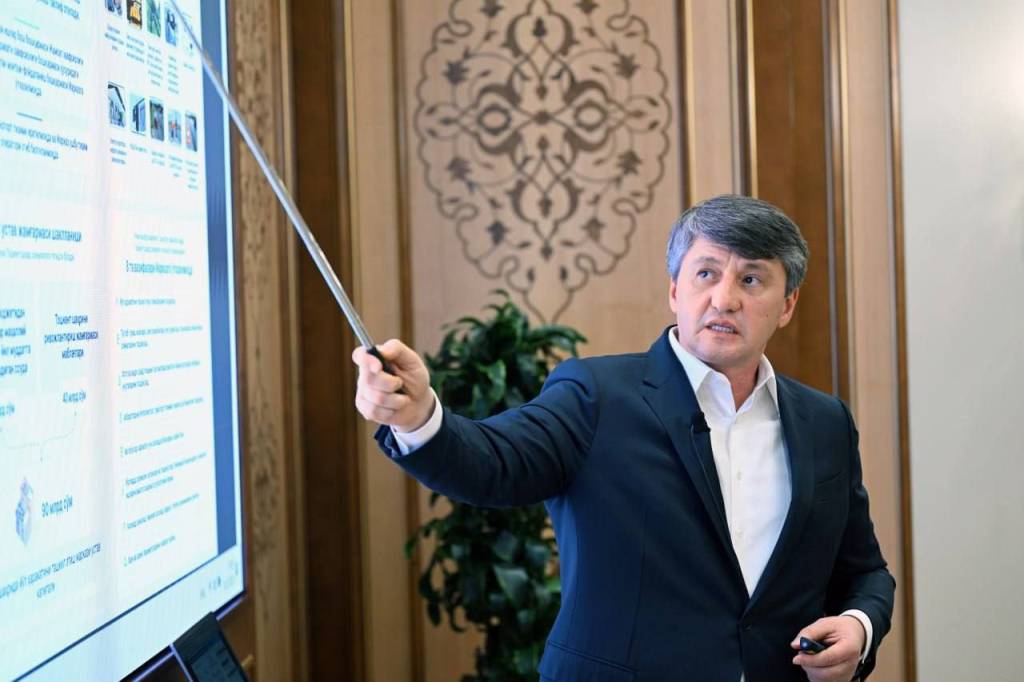
The center will be responsible for analyzing and modeling transport and pedestrian flows, implementing and managing the intelligent transport system, developing and executing the transport master plan and framework, organizing urban parking, expanding infrastructure for electric-vehicle charging, and promoting the use of personal mobility devices.
The center will operate the intelligent transport system. This platform will analyze data, including through the use of artificial intelligence, collected from cameras, sensors, and GPS devices, and will be capable of maintaining statistics, forecasting congestion, optimizing routes, adaptively adjusting traffic-light phases, and dispatching emergency services in the event of traffic accidents.
As a result of the system’s implementation, average travel time is expected to decrease, emergency services will reach accident sites more quickly, and the number of traffic jams and accidents on major roads will decline.
The President approved the proposals and instructed that a pilot project be launched this year, expanded in the following years, and integrated into the regions by 2030.
UzA