

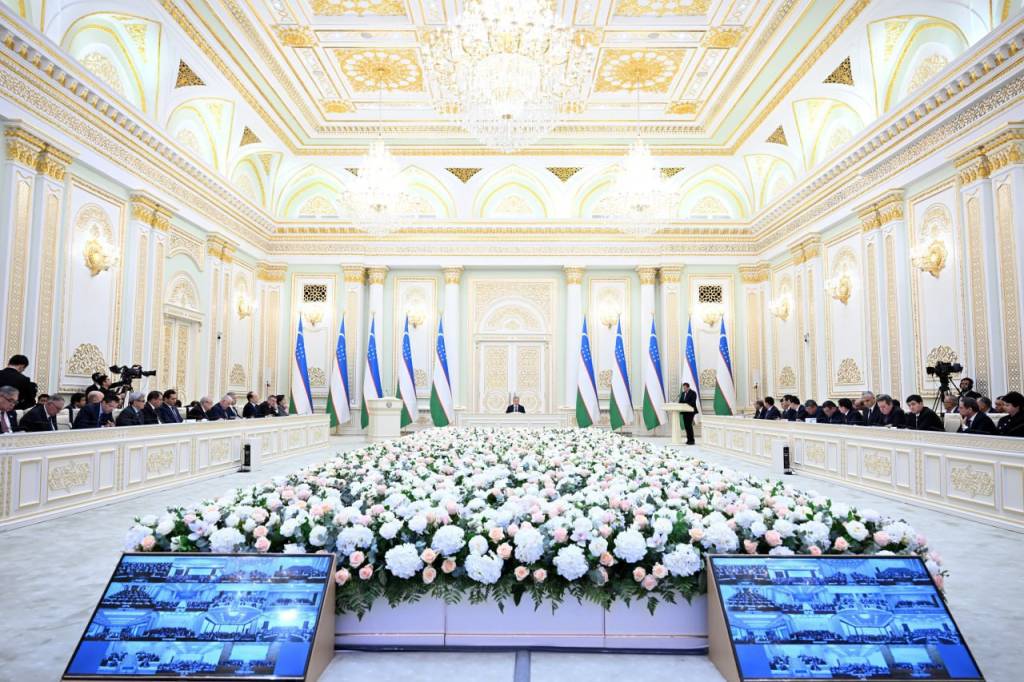
On January 15, President Shavkat Mirziyoyev chaired a videoconference meeting on the activities of the Ministry of Foreign Affairs and diplomatic missions abroad.
Opening the session, the Head of State noted that the meeting is taking place amid sharp geopolitical changes worldwide and rising threats to states’ sovereignty. In this regard, the need to critically assess current foreign policy activities and to adopt a renewed approach to organizing the work of the Ministry of Foreign Affairs and foreign diplomatic missions was emphasized.
The President noted that 2025 had been a productive year for the country’s foreign policy. During the year, high-level visits were made to 26 foreign countries, and for the first time in recent history, leaders from several countries visited Uzbekistan. Multilateral dialogues in the “Central Asia Plus” format became productive. In recent years, strategic partnerships have been established with 11 countries, bringing the total number to 19, and allied relations have been built with Kazakhstan, Azerbaijan, and Tajikistan.
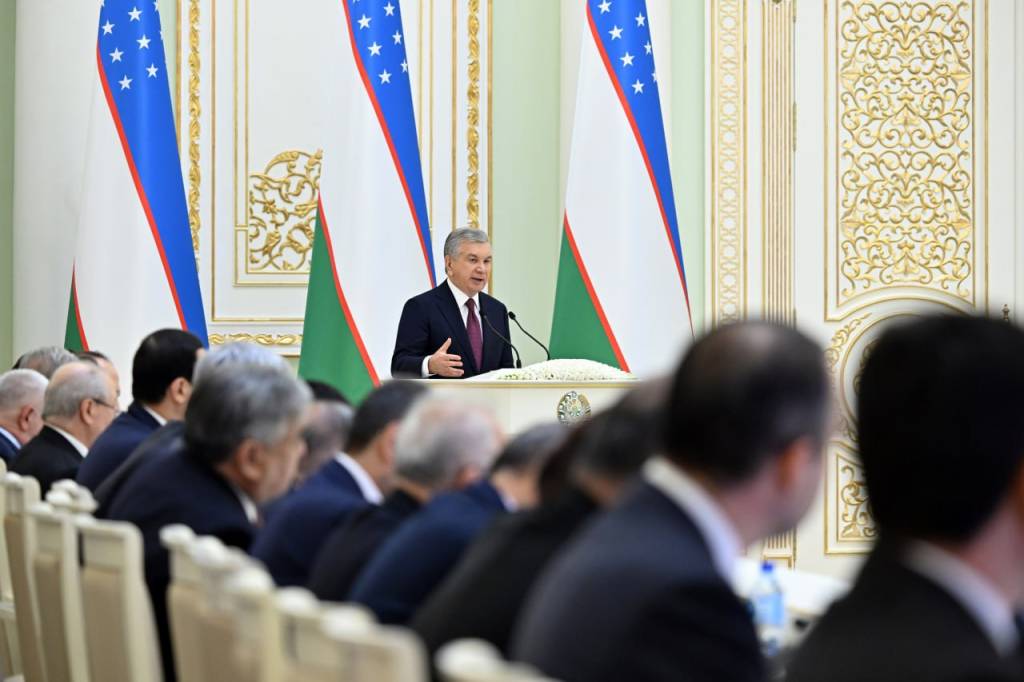
“As a result of an open, pragmatic, thoughtful and proactive foreign policy, Uzbekistan is consistently strengthening its position as one of the global centres of peace and diplomacy”, emphasized the President.
Since 2017, 16 new diplomatic missions and consulates have been opened abroad, bringing the total to 60 and the number of countries with which diplomatic relations have been established to 165. There has also been an increase in the number of staff and in employee salaries across embassies, consular offices, representative offices of international organizations, and the Ministry of Foreign Affairs.
At the same time, a fundamental question was raised about whether all diplomatic missions are fully leveraging available opportunities.
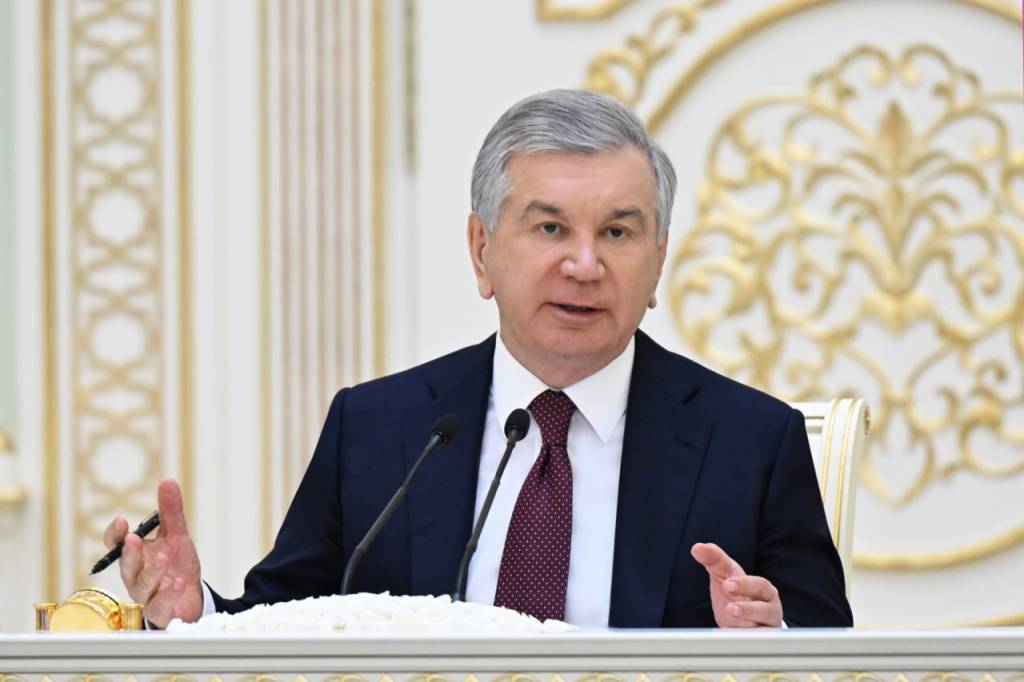
“In the current environment, an ambassador is not just a person who conducts political dialogue. An ambassador is a state representative who attracts investment and technologies, opens new export markets, launches transport and logistics corridors, increases tourist flows, creates conditions for legal labor migration, and, most importantly, protects the rights of our citizens”, emphasized the President.
In this regard, it was noted that key performance indicators for ambassadors should include export revenue from countries of residence, growth in tourist flows, and the effectiveness of managing legal labor migration.
Particular emphasis was placed on the need to increase exports and investments by strengthening economic diplomacy.

As part of bilateral and multilateral events in 2025, agreements were signed on investment projects and trade contracts totaling $160 billion. For the first time in history, foreign trade turnover exceeded $80 billion, exports reached $33.5 billion, and foreign investment exceeded $43 billion. Exports to 75 countries increased by almost $4,5 billion.
In view of this, the ambassadors have been tasked with expanding export deliveries to the Middle East, Europe, Asia, and Africa, and with implementing specific projects in industry, agriculture, the chemical and textile industries, greenhouse farming, and the service sector. At the same time, Uzbekistan’s products remain insufficiently recognized in specific markets.
It was noted that rising logistics costs negatively affect the competitiveness of domestic products. In this regard, the need to diversify transit routes, optimize logistics chains, and develop additional proposals to reduce transportation costs when entering European markets was indicated.
In the agricultural sector, tasks have been set to research and implement water-saving technologies, modern agricultural technologies, and innovative greenhouse solutions. In addition, measures have been outlined to expand export markets for chemical industry products, bring domestic manufacturers into line with international standards and requirements, and organize specialized exhibitions and presentations.
The need to intensify trade and economic cooperation with Africa, a promising new export destination, was emphasized. To this end, instructions were issued to develop a clear roadmap in collaboration with relevant ministries and overseas diplomatic missions.
It was noted that ambassadors should be directly interested in finding promising projects, attracting them, and implementing them in practice. In this regard, it was decided to introduce financial incentives for ambassadors who bring specific investment or export projects to a logical conclusion.
Insufficient use of existing potential in several areas was criticized. In particular, it was noted that opportunities to attract international grants are not being fully used. It was emphasized that, with closer, more systematic interaction among ministries, sectoral leaders, and ambassadors, at least $200-300 million in additional grant funding could have been secured last year.
As noted, international organizations and donor countries announce grant programs worth approximately $200 billion annually. In this regard, the task is to implement a unified, systematic, and practical approach to managing grants.
In addition, the need to take concrete measures, together with ambassadors to the United States, the United Kingdom, Germany, Switzerland, China, Japan, and Singapore, to attract leading foreign universities ranked in the top 100 worldwide as partners for Uzbekistan’s higher education institutions was emphasized.
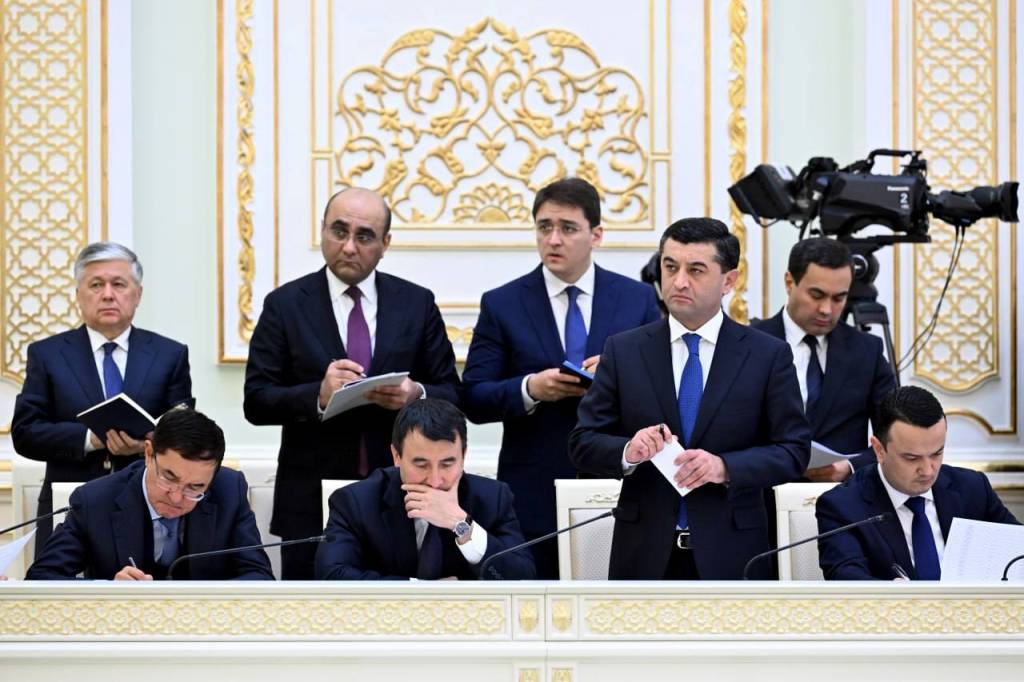
It was noted that cooperation between regions and diplomatic missions to expand foreign economic relations remains insufficient. The need for active participation by regional governors, together with ambassadors, in the systematic promotion of regional export-oriented products and in facilitating the entry of local enterprises into foreign markets was emphasized.
Providing Uzbek citizens with legal, high-paying jobs abroad was identified as another priority. The expansion of the geography of organized labor migration was noted, and several countries were identified as not sufficiently effective in this area. Relevant instructions were issued accordingly.
It was emphasized that embassies and consulates should actively protect the rights and legitimate interests of citizens and provide qualified legal assistance in each specific case. The task has been set to abandon “office diplomacy”, strengthen work in the field, and establish direct dialogue with compatriots.
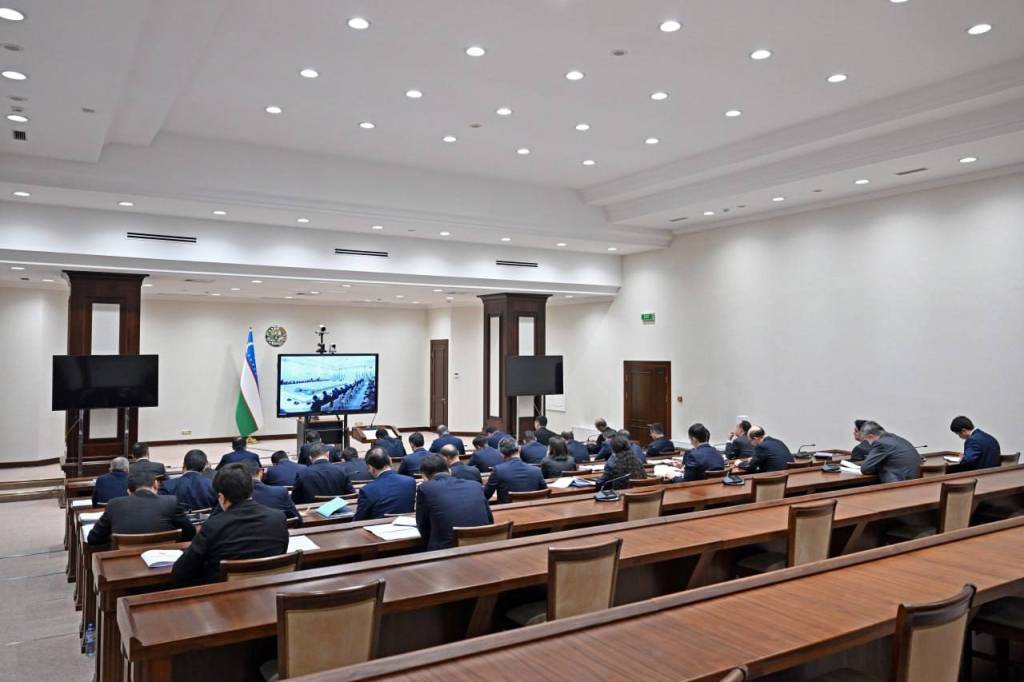
In the field of tourism, the need to further strengthen the role of ambassadors, introduce new approaches to promoting the country’s tourism and cultural potential, make effective use of visa-free regimes, and attract international outsourcing companies has been identified.
Issues related to expanding foreign policy ties, the high-quality, timely preparation of high-level visits, retraining of diplomatic personnel, and the development of a reserve of promising specialists were also discussed.
The intensification of foreign information policy and the improvement of the country’s international image through systematic work with foreign media and the implementation of special media projects were identified as priority tasks.
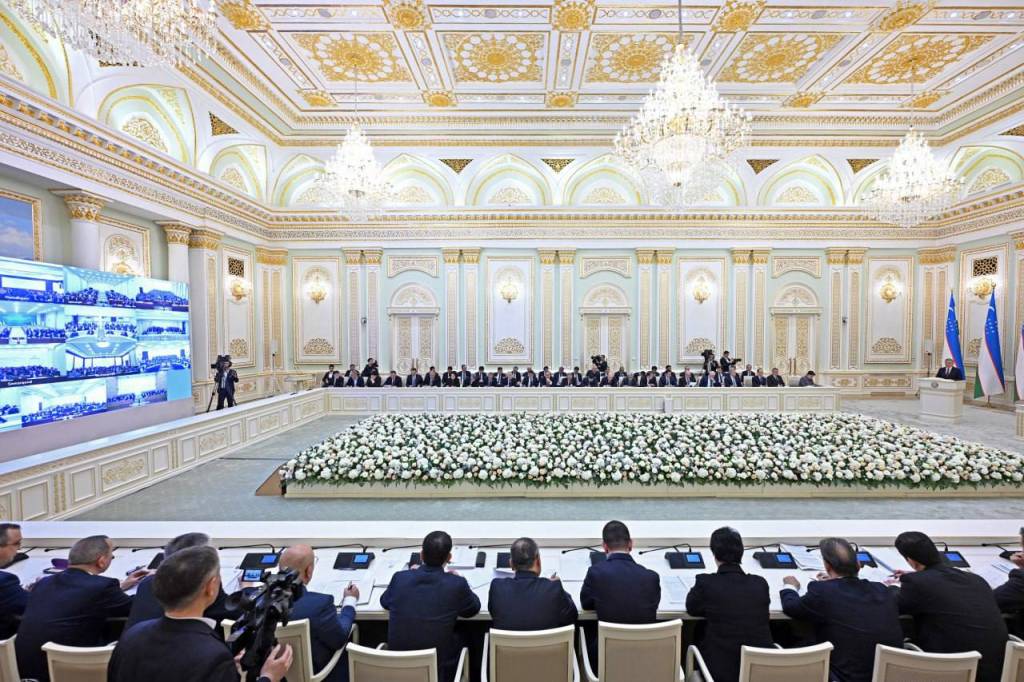
The need to update the Concept of foreign policy of the Republic of Uzbekistan, review its priority areas, and define clear tasks for protecting national interests and strengthening the country’s position in the international arena was emphasized.
As the President noted, the new concept should comprehensively reflect long-term strategic goals, the logic of internal reforms, and national interests across economic diplomacy, security, investment, exports, transport and logistics, and water and climate issues.
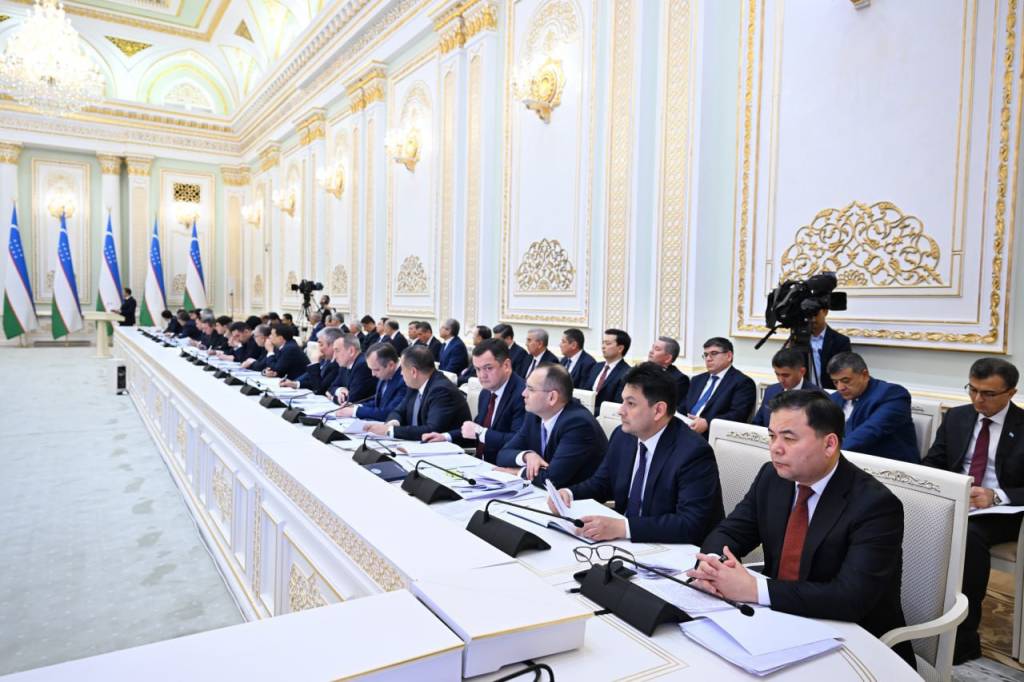
To properly recognize the achievements of diplomats, it was proposed to establish the honorary title of “Honored Diplomat of the Republic of Uzbekistan”.
Following the meeting, President Shavkat Mirziyoyev emphasized: “The time has come for a new generation of diplomats – those who achieve concrete results and firmly defend the interests of Uzbekistan in the international arena”.
During the session, our ambassadors’ reports and proposals from abroad were heard.
UzA